Türkçe
Jordanian and Moroccan Opposition in the Post-Arab Spring Period
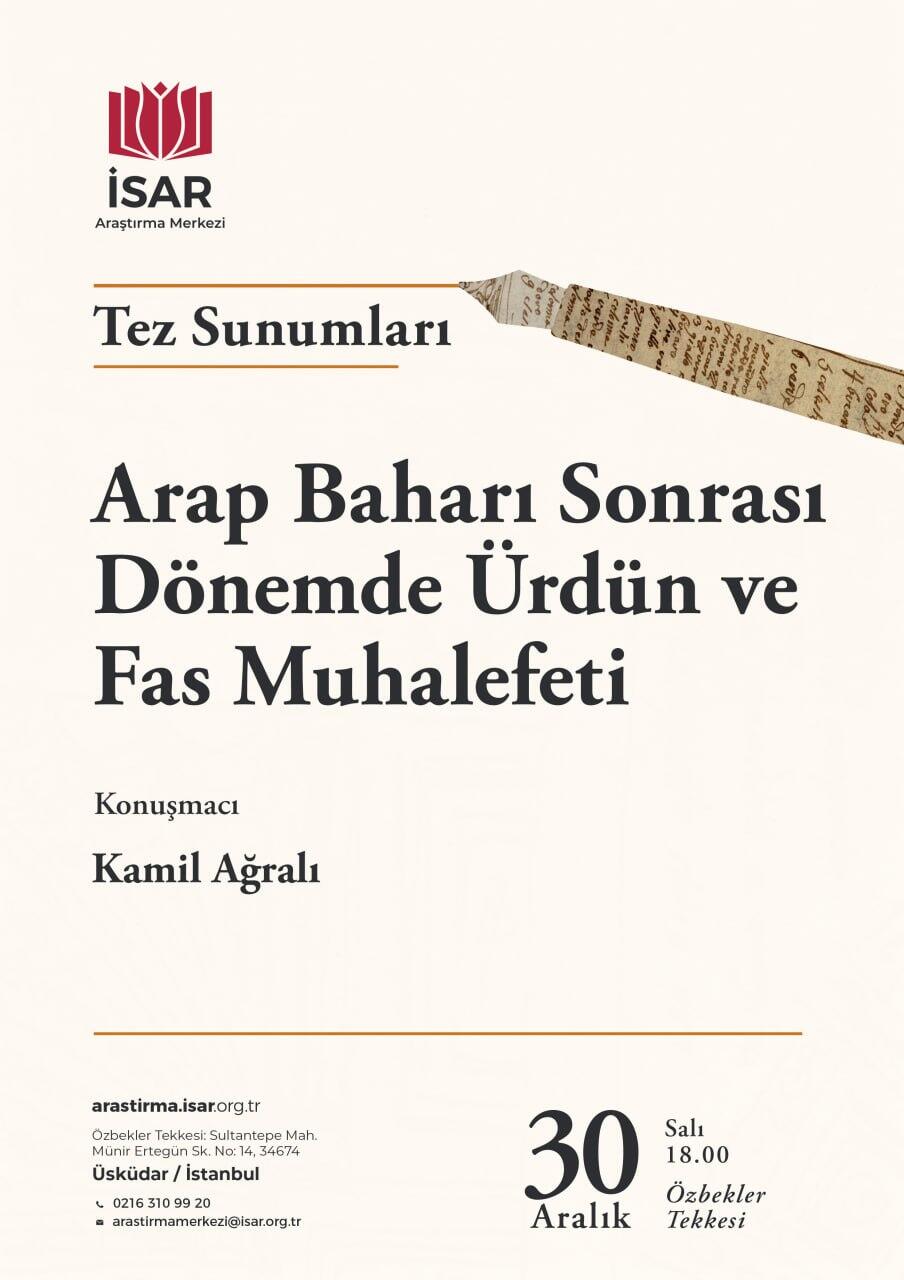
In the 32nd session of our ISAR Thesis Presentations series, we will host Kamil Ağralı to discuss his master’s thesis titled "Jordanian and Moroccan Opposition in the Post-Arab Spring Period."
In his thesis, Kamil Ağralı examines the diverging trajectories of the leading Islamist opposition parties—the Islamic Action Front Party (IAF) in Jordan and the Justice and Development Party (PJD) in Morocco—in the aftermath of the Arab Spring. Synthesizing the literatures on Islamist moderation and opposition strategies in electoral authoritarian regimes, the thesis argues that following their inclusion into the political system, Islamists adopted a multi-dimensional core strategy termed "strategic moderation."
The study posits that rather than maintaining a conflictual-critical opposition—which could lead to easy suppression or disqualification by regime elites—these parties focused on gradual gains by aligning their discourse, behavior, and organizational preferences with the institutional logic and "red lines" of the regime.
Applying the Most Similar Systems Design (MSSD) and a comparative process-tracing approach, the thesis contends that the diverging paths of these two parties were shaped by the PJD’s successful implementation of strategic moderation, contrasted with the IAF’s failure to do so. The IAF’s shift toward a more confrontational and combative line was driven by the influence of a rising, hawkish Palestinian faction within the party. Furthermore, the thesis argues that the capacity to implement strategic moderation may be significantly constrained when an Islamist party is dominated by actors from a politically marginalized or minority group, as exemplified by the Palestinian case in Jordan.
Sosyal Medyada Paylaş Google Takvime Ekle + iCal / Outlook export